SPOILERS follow
I had semi-big expectations for Terminator Salvation, not because I'm a huge fan of the franchise - not really - but because of the pedigree. Christian Bale as John Connor leading the resistance after Judgement Day? Say no more. Jonathan Nolan (who wrote The Dark Knight) co-writing the screenplay? Yes. Bryce Dallas Howard? Yes. McG? Um... ok, so McG gives you pause. I had a wait and see attitude with him and to his credit, he goes for a look and achieves it. It's just not the look anyone expected or necessarily wanted. Or one that's original.
The future in this movie looks like one that someone who just saw Blade Runner or Mad Max might think would be cool. It's not the dark, cratered landscape suggested in the earlier films, a landscape literally crawling with machines; in fact, the surface is remarkably untended by SkyNet, to the degree that the Resistance somehow manages an fleet of workable A-10 Warthogs and Ospreys that they can park out in a traditional airfield without fear of being nuked to kingdom come by SkyNet. They can fly them without too much fear of being shot down, because SkyNet, despite its name, seems to not have any air superiority. SkyNet in fact has a minimal presence in the world outside of its base in San Fransisco, where it conveniently decides to centrally locate its resources. The entire ethos of the film is wrong. This is the same issue I had the X-Men films; it's hard to take the underdog plight of mutants seriously when they live in a tricked out mansion and fly around in a supersonic jet. The X-Men worked best when they were on the run, living off scraps. The future Kyle Reese described in the original 1984 film is not reflected here.
John Connor is another huge let down. Christian Bale spends most of his time on screen - very little of it - shouting into a microphone. He seems bored. You don't engage with the character at all, and the others, his wife Kate, Barnes - they're just there. The main character is a man named Marcus. Marcus first appears in a misguided prologue as a death row inmate about to be executed. Helena Bonham Carter shows up with some papers for him to donate his organs to Cyberdyne systems - SkyNet's authors - and they share some horrible dialogue and acting and he dies.
Marcus shows up again in 2018, and becomes the focal point of the story. We know he's a machine before he does, but the Frankenstein element has enormous potential. None of which materializes. He runs into Kyle Reese, very well played by Anton Yelchin, also in Star Trek, runs into a Resistance fighter named Blair who has no integrity and no common sense about her, and eventually into the man himself. All of it goes nowhere. They eventually invade SkyNet Central because Kyle Reese has been captured, and John Connor needs to make sure he's born because he's so damned important. Not even his wife seems to think so. SkyNet knows who Kyle is - and rather than simply kill him right then and there, creates an elaborate plan to trap Connor and kill them both. Somehow Marcus fits into this as the only way Connor could be duped, all of its horrifically explained in a EARTH STOPPING scene from Helena - I mean, SkyNet - which rivals the Architect scene from The Matrix as the most stupefying exposition dump in film history.
There are some nice moments - seeing 1984 Arnold for a minute, in what has to be the best human CGI ever (remember The Scorpion King? It was bad!) - but mostly the film fails the promise of the first two. The real issue is who the main character is. That was the failure of the third one, this one and likely every film to come after. The main character is not the T-800. It's not John Connor, who has turned out to be the least interesting protagonist in this genre. It's not Kyle Reese. It's Sarah Connor. She has been the focal point of the series from the get-go, and her absence virtually undid the third one. Her presence in this one, as a ghostly voice, only reinforces the fact that the series has lost its bearings. The original film, like Aliens, was about a woman standing up in the world of men and their machines. The series gradually shifted to John Connor, necessarily maybe, but in doing so it lost its heart. Now, this film can't have Sarah because she's gone and its decades after. This film shouldn't be. It serves no purpose - it ends with only the promise there will be more. That may not be a good thing.
Sunday, May 24, 2009

Saturday, May 23, 2009
On Third Thought
After my third viewing of Star Trek - I have also seen Terminator, review forthcoming (check out Ben's take on it at his blog) - I think I finally figured out why the only soft spot in the movie - the big bad - doesn't work. The entire movie hinges on the idea that an alternate reality has been created by Nero's travel back through time. He substantially alters the course of history, first with the encounter with the USS Kelvin, and then the destruction of Vulcan.
Nero is one upset Romulan because a star exploded and destroyed his planet. The Vulcans - led by Spock - agreed to help by creating a black hole to swallow the star, but arrived too late. In the movie Nero takes this out on Spock and Vulcan by destroying Vulcan with the same black hole stuff. The problem is, Nero wants to insure his wife and child will survive, but that star is still going to go nova in 129 years time; his first priority should be destroying that. From his point of view, doing so would save Romulus and erase the future that has left him alone and stranded in the past; what should have happened is that Nero destroys the star - I'm pretty sure it's the same star he emerges at in the opening scene - and he doesn't blink out of existence. All is not right; he still exists, and so the future - his future - still does. He can't undo anything. Then, his crusade becomes one of torching the earth. If there will be no future for his wife, there won't be one for anybody.
Nero is one upset Romulan because a star exploded and destroyed his planet. The Vulcans - led by Spock - agreed to help by creating a black hole to swallow the star, but arrived too late. In the movie Nero takes this out on Spock and Vulcan by destroying Vulcan with the same black hole stuff. The problem is, Nero wants to insure his wife and child will survive, but that star is still going to go nova in 129 years time; his first priority should be destroying that. From his point of view, doing so would save Romulus and erase the future that has left him alone and stranded in the past; what should have happened is that Nero destroys the star - I'm pretty sure it's the same star he emerges at in the opening scene - and he doesn't blink out of existence. All is not right; he still exists, and so the future - his future - still does. He can't undo anything. Then, his crusade becomes one of torching the earth. If there will be no future for his wife, there won't be one for anybody.
Top 10 Rules of Time Travel
Because of Star Trek, Terminator, and the fact it's all I've been going on about forever with my buds:
Debate.
Debate.
Friday, May 22, 2009

Saturday, May 16, 2009
Land of the Jawas
So, last week or so I mentioned I scored a Regal Jawa. He has now safely arrived and taken his rightful place in my collection. And it occured to me I've never really shown my collection here, so here are some photos:
(click to make bigger)
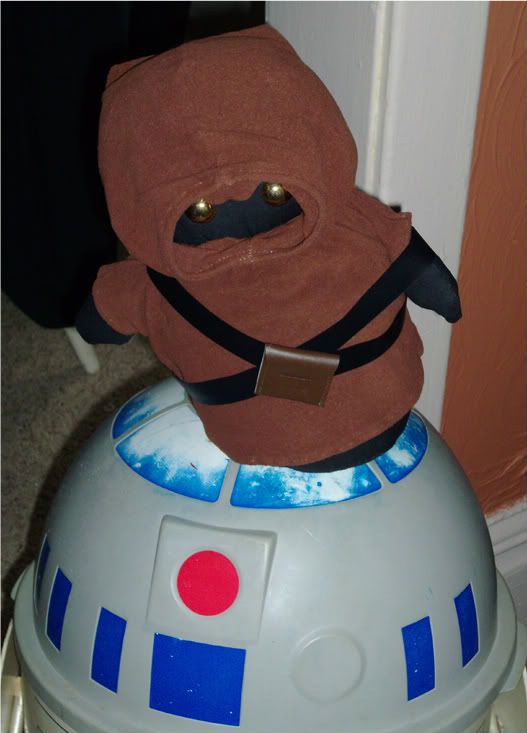
The lil' guy:

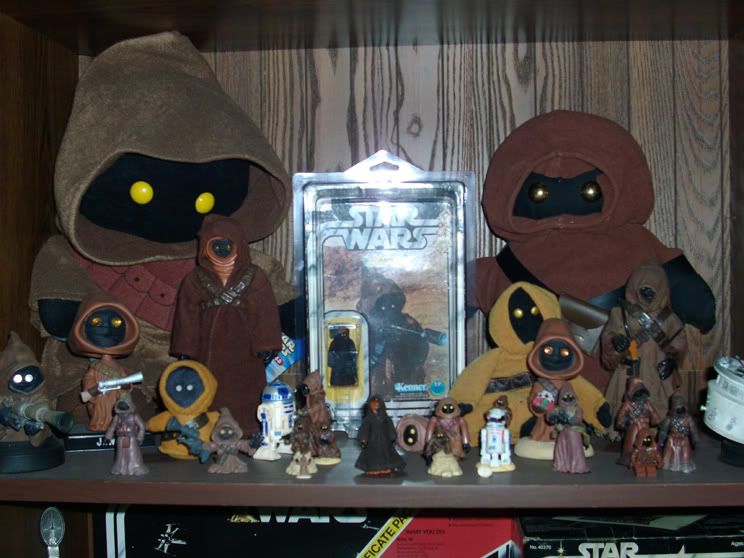
My Jawas:

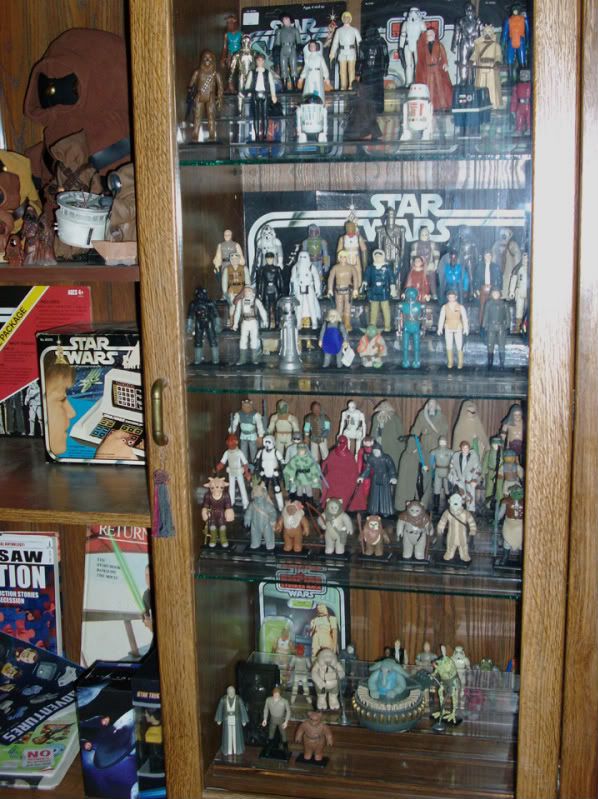
My vintage figure collection (missing 13 of the last 17):

I will try and take some pics of my modern collection and better ones of the vintage collection later.
(click to make bigger)
The lil' guy:
My Jawas:
My vintage figure collection (missing 13 of the last 17):
I will try and take some pics of my modern collection and better ones of the vintage collection later.
Friday, May 15, 2009

Sunday, May 10, 2009
Saturday, May 9, 2009
I Have Been And Always Shall Be Your Friend
SPOILERS follow
Everyone who knows me knows I'm a Star Wars baby, but during that long period between Jedi and 96/97 when Episode I finally started to become a reality, I was still a space geek annd Star Trek was where I got my fix. I saw the movies, the TOS reruns in the afternoons after school, but it wasn't until The Next Generation that I really got into it. I love astronomy and space ships, so Star Trek more than Star Wars appeals to the Dude-I-Want-To-Be-An-Astronaut side of me (plus there's actual characters). Star Trek also inspired me as a writer; I still remember reading interviews with Michael Piller in the original Star Trek Communicator about the process of writing. He spoke sometimes about 'zen writing', an idea that non-outline writers like me love because things seem to naturally fall into place. You discover something in your story as you write it, and you come away not only with the joy of discovery, but the feeling that really, that's how it always was.
That's how this new film feels.
When it was first announced J.J. Abrahms was taking over the franchise, I had my doubts. Not about him; I love just about everything he does on TV. I didn't know that Star Trek had any life left in it, especially after a good decade or more of aimless banality. The only place to go was back to the past, and the risks there are obvious. I can say now that not only did he succeed my wildest expectations, he absolutely obliterated them. The film essentially goes back to Kirk and Spock - back to their very births - and starts over fresh. However, the it's not a rehash of what's gone before because history has been changed by a Romulan named Nero who is whisked back in time. Nero is tattooed and angry and takes it out on a spaceship that happens to have Kirk's dad on it. Kirk's dad dies, and it's the first of MANY things that zig where they should have zagged before. The film manages to honor the past - Leonard Nimoy appears in a scene with the new Kirk, Chris Pine (instant star) that recalls so many good moments from the past, and erases so many of the bad - and also chart a new path. The film clearly establishes that Nero's actions have created a new timeline - an alternate one - and things will not proceed normally.
This all seems obtuse to a non Trekkie but really, it's an ounce of the film. The rest of it is a hilarious, blistering action romp that is more like Raiders or a New Hope than any other Trek film. The movie consciously echoes A New Hope in several ways - the farm boy hero; the looking at the suns like looking at the Enterprise moment; the destruction of a planet by a big ass spaceship; the bar scene - and none of them seem to try to shrink the ethos of Trek to that of Wars. Trek can be what it always has been - optimistic, outward looking, fun - and still be wall to wall adventure. This is a great achievement for Abhrams and a joy for Trek fans who may have feared that there never would be any more 23rd century joy.
The Great:
They built the Enterprise in Iowa. In Riverside. For a boy from Iowa who dreamed of space growing up, that is the single coolest thing in the history of cool. They still never would have gotten it off the ground though.
The casting is perfect. Pine, Zachary Quinto, Simon Pegg - Jesus, Simon Pegg - and most of all Karl Urban as Bones not only pay tribute to actors no one thought replaceable, they prove the characters are not.
Zoe Saldana.
The Kobyashi Maru. "I... understand."
The upside down skyscrapers on Vulcan.
The pipeworks engineering section of the Enterprise. Hey, remember when it was a cardboard room with a chair?
"I have been and always shall be your friend."
The emergence of the Enterprise from Titan.
The Enterprise. Still love the 'A' version the most, but this thing is gorgeous.
The jump to the drill.
The set of the Narada - the most unique set I've seen in a long time.
The music - outstanding, big and epic.
The sound effects are simultaneously original and throwbacks, and generally iconic. The Enterprise always sounded like an ocean liner going by before; now it sounds like a supersonic train so fast you barely hear it at all.
Go see this. Several times. Like I will.
Everyone who knows me knows I'm a Star Wars baby, but during that long period between Jedi and 96/97 when Episode I finally started to become a reality, I was still a space geek annd Star Trek was where I got my fix. I saw the movies, the TOS reruns in the afternoons after school, but it wasn't until The Next Generation that I really got into it. I love astronomy and space ships, so Star Trek more than Star Wars appeals to the Dude-I-Want-To-Be-An-Astronaut side of me (plus there's actual characters). Star Trek also inspired me as a writer; I still remember reading interviews with Michael Piller in the original Star Trek Communicator about the process of writing. He spoke sometimes about 'zen writing', an idea that non-outline writers like me love because things seem to naturally fall into place. You discover something in your story as you write it, and you come away not only with the joy of discovery, but the feeling that really, that's how it always was.
That's how this new film feels.
When it was first announced J.J. Abrahms was taking over the franchise, I had my doubts. Not about him; I love just about everything he does on TV. I didn't know that Star Trek had any life left in it, especially after a good decade or more of aimless banality. The only place to go was back to the past, and the risks there are obvious. I can say now that not only did he succeed my wildest expectations, he absolutely obliterated them. The film essentially goes back to Kirk and Spock - back to their very births - and starts over fresh. However, the it's not a rehash of what's gone before because history has been changed by a Romulan named Nero who is whisked back in time. Nero is tattooed and angry and takes it out on a spaceship that happens to have Kirk's dad on it. Kirk's dad dies, and it's the first of MANY things that zig where they should have zagged before. The film manages to honor the past - Leonard Nimoy appears in a scene with the new Kirk, Chris Pine (instant star) that recalls so many good moments from the past, and erases so many of the bad - and also chart a new path. The film clearly establishes that Nero's actions have created a new timeline - an alternate one - and things will not proceed normally.
This all seems obtuse to a non Trekkie but really, it's an ounce of the film. The rest of it is a hilarious, blistering action romp that is more like Raiders or a New Hope than any other Trek film. The movie consciously echoes A New Hope in several ways - the farm boy hero; the looking at the suns like looking at the Enterprise moment; the destruction of a planet by a big ass spaceship; the bar scene - and none of them seem to try to shrink the ethos of Trek to that of Wars. Trek can be what it always has been - optimistic, outward looking, fun - and still be wall to wall adventure. This is a great achievement for Abhrams and a joy for Trek fans who may have feared that there never would be any more 23rd century joy.
The Great:
They built the Enterprise in Iowa. In Riverside. For a boy from Iowa who dreamed of space growing up, that is the single coolest thing in the history of cool. They still never would have gotten it off the ground though.
The casting is perfect. Pine, Zachary Quinto, Simon Pegg - Jesus, Simon Pegg - and most of all Karl Urban as Bones not only pay tribute to actors no one thought replaceable, they prove the characters are not.
Zoe Saldana.
The Kobyashi Maru. "I... understand."
The upside down skyscrapers on Vulcan.
The pipeworks engineering section of the Enterprise. Hey, remember when it was a cardboard room with a chair?
"I have been and always shall be your friend."
The emergence of the Enterprise from Titan.
The Enterprise. Still love the 'A' version the most, but this thing is gorgeous.
The jump to the drill.
The set of the Narada - the most unique set I've seen in a long time.
The music - outstanding, big and epic.
The sound effects are simultaneously original and throwbacks, and generally iconic. The Enterprise always sounded like an ocean liner going by before; now it sounds like a supersonic train so fast you barely hear it at all.
Go see this. Several times. Like I will.
Wednesday, May 6, 2009
Space Operatics
io9 gives the top 10 rules of space opera in honor of Star Trek (one more day!) so go check them out. Since I am writing my own little space opera presently, I'd thought I check what I got their list:
1. Have a giant object in space.
Check.
2. Set the action in motion by plunging us into the middle of an extremely complicated astropolitical regime change.
Right with you until regime change. My astropolitical is complicated, though.
3. A scrappy group of humans should be part of a rebellion that's hidden on a cool-looking moon or tricked-out asteroid.
Not doing so good here. Though my good guys do live underground...
4. There must be an enormous mothership (which must be referred to as a mothership or maybe a base ship), and it must be attacked by a bunch of tiny fighter ships.
This is so cliche, I avoid it altogether.
5. Always fill your spaceships and intergalactic ports with random background aliens and weird-faced creatures.
Naturally.
6. Your heroes should always revisit the sites of old battles, the locations of terrible accidents, and the regions of space where their people were wiped from the face of the universe. But only if they don't want to.
My heroes sift through the ash of the universe. It's kind of the book.
7. If there is a male bad guy, he should have a ripped body or amazing weapons. If there is a female bad guy, she should have a high, sparkly collar or a sidekick named something like Tigerman.
Um... no. I have a guy and a girl as the baddies, though. They are neither ripped or sparkly. But they rip and make sparkles of other people.
8. There should be at least three types of weapon and three types of spaceship, each of which will be given a name that is used repeatedly.
There are three types of spaceships, because spaceships are awesome.
9. There should be a captain. If there is not a captain, there should be a special agent. If there is not a special agent, there should be a cadet with a future. If there is no cadet with a future, there should be a mercenary with a dark past.
There is someone with a dark past.
10. Somebody wise should predict something, but nobody will pay attention or be able to understand the prediction.
Dude, it's a space opera!
1. Have a giant object in space.
Check.
2. Set the action in motion by plunging us into the middle of an extremely complicated astropolitical regime change.
Right with you until regime change. My astropolitical is complicated, though.
3. A scrappy group of humans should be part of a rebellion that's hidden on a cool-looking moon or tricked-out asteroid.
Not doing so good here. Though my good guys do live underground...
4. There must be an enormous mothership (which must be referred to as a mothership or maybe a base ship), and it must be attacked by a bunch of tiny fighter ships.
This is so cliche, I avoid it altogether.
5. Always fill your spaceships and intergalactic ports with random background aliens and weird-faced creatures.
Naturally.
6. Your heroes should always revisit the sites of old battles, the locations of terrible accidents, and the regions of space where their people were wiped from the face of the universe. But only if they don't want to.
My heroes sift through the ash of the universe. It's kind of the book.
7. If there is a male bad guy, he should have a ripped body or amazing weapons. If there is a female bad guy, she should have a high, sparkly collar or a sidekick named something like Tigerman.
Um... no. I have a guy and a girl as the baddies, though. They are neither ripped or sparkly. But they rip and make sparkles of other people.
8. There should be at least three types of weapon and three types of spaceship, each of which will be given a name that is used repeatedly.
There are three types of spaceships, because spaceships are awesome.
9. There should be a captain. If there is not a captain, there should be a special agent. If there is not a special agent, there should be a cadet with a future. If there is no cadet with a future, there should be a mercenary with a dark past.
There is someone with a dark past.
10. Somebody wise should predict something, but nobody will pay attention or be able to understand the prediction.
Dude, it's a space opera!
Sunday, May 3, 2009
There's A Naked Man In Our Barn
SPOILERS
I went with Ben yesterday to see Wolverine: X-Men Origins, or whatever it's called. It was utterly lifeless. Hugh Jackman is always a treat, but here he's disserviced by a script that has him tricked into getting an operation that makes him indestructible, because - follow with me now - he wouldn't otherwise volunteer for it. So his boss makes his brother kill his girlfriend so he'll volunteer, but he didn't really kill her because she was playing him the whole time to get him to volunteer. And his brother, who is killing everyone else, didn't kill the girlfriend of his baby brother who he loves and protects because... why?
The direction is very poor. Gavin Hood never really knows where to put the camera, unless it's ten feet over Jackman's head so he can scream when someone's dead. Also, why is it that no one knows how to film a car chase anymore? The helicopter/bike thing you've seen in the previews is okay, except most of it is filmed in front of a green screen (watch Death Proof to see that is still possible to film a car chase practically). The green screen is really distracting, because the effects are equally poor - the CGI in these X-Men movies never seems to be on par with other big movies, and this one is particularly bad. The final sequence on top of a nuclear reactor (yeah) seems like it came from a video game about ten years ago. The rendering on most everything (including a wonky cameo by Patrick Stewart) looks cheap. That five different effects houses - none of them ILM - contributed to this movie seems to say everything. The fight scenes are weak. Wolverine spends a lot of time screaming. They completely shaft Deadpool, and Gambit, the only bright spot in the movie, is hardly there.
Moving on.
I went with Ben yesterday to see Wolverine: X-Men Origins, or whatever it's called. It was utterly lifeless. Hugh Jackman is always a treat, but here he's disserviced by a script that has him tricked into getting an operation that makes him indestructible, because - follow with me now - he wouldn't otherwise volunteer for it. So his boss makes his brother kill his girlfriend so he'll volunteer, but he didn't really kill her because she was playing him the whole time to get him to volunteer. And his brother, who is killing everyone else, didn't kill the girlfriend of his baby brother who he loves and protects because... why?
The direction is very poor. Gavin Hood never really knows where to put the camera, unless it's ten feet over Jackman's head so he can scream when someone's dead. Also, why is it that no one knows how to film a car chase anymore? The helicopter/bike thing you've seen in the previews is okay, except most of it is filmed in front of a green screen (watch Death Proof to see that is still possible to film a car chase practically). The green screen is really distracting, because the effects are equally poor - the CGI in these X-Men movies never seems to be on par with other big movies, and this one is particularly bad. The final sequence on top of a nuclear reactor (yeah) seems like it came from a video game about ten years ago. The rendering on most everything (including a wonky cameo by Patrick Stewart) looks cheap. That five different effects houses - none of them ILM - contributed to this movie seems to say everything. The fight scenes are weak. Wolverine spends a lot of time screaming. They completely shaft Deadpool, and Gambit, the only bright spot in the movie, is hardly there.
Moving on.
Friday, May 1, 2009
A Holy Grail
I could not pass it up.
I am a lifelong Star Wars fan. Of all the Star Wars goodness I enjoy, I enjoy Jawas the most. I tend to buy all things Jawa and if they're old things Jawa - and rare - I have had them on a wishlist for years now. # 1 on that list is the incredibly hard to come by Regal plush Jawa only available in Canada in 1978. This thing is nearly mythic, and thanks to the auction above, I am now the proud owner of a complete (!) Regal Jawa for a extraordinarily fair price.
The last Jawa left is the even more rare and mythic vinyl cape Jawa. This thing runs in the thousands of dollars and will not be had by me for some time (if ever). In some ways the Regal Jawa is more of a catch - I actually had a couple vinyl jawas as a kid, and happily lost them in the course of playing with them. Beyond that, there isn't a piece left on my Jawa list. Well, there are Jawa things - I still don't have a Sandcrawler. But I have my 12 back carded '78 Jawa. My Lego Jawa (WTF this thing is so hard to get). My Japanese plush giant Jawa.
But I still have several vintage Star figures I never owned - all from the rare 1985 series that few people saw - and I am knocking off those, one at a time.
I am a lifelong Star Wars fan. Of all the Star Wars goodness I enjoy, I enjoy Jawas the most. I tend to buy all things Jawa and if they're old things Jawa - and rare - I have had them on a wishlist for years now. # 1 on that list is the incredibly hard to come by Regal plush Jawa only available in Canada in 1978. This thing is nearly mythic, and thanks to the auction above, I am now the proud owner of a complete (!) Regal Jawa for a extraordinarily fair price.
The last Jawa left is the even more rare and mythic vinyl cape Jawa. This thing runs in the thousands of dollars and will not be had by me for some time (if ever). In some ways the Regal Jawa is more of a catch - I actually had a couple vinyl jawas as a kid, and happily lost them in the course of playing with them. Beyond that, there isn't a piece left on my Jawa list. Well, there are Jawa things - I still don't have a Sandcrawler. But I have my 12 back carded '78 Jawa. My Lego Jawa (WTF this thing is so hard to get). My Japanese plush giant Jawa.
But I still have several vintage Star figures I never owned - all from the rare 1985 series that few people saw - and I am knocking off those, one at a time.
Sunday, April 26, 2009
They're Not Dolls... They're Action Figures!
By far the most insightful take on Dollhouse yet.
This is a difficult, uneven show that in the last few weeks has really been exploiting its potential - limitless, it now seems - and if Fox allows it to go on, there may be rewards in them there hills. I would hate to see it go because I am endlessly fascinated by Dichen Lachman, who displays a dexterity in her acting that really makes up for the lack of any real regular character.
This is a difficult, uneven show that in the last few weeks has really been exploiting its potential - limitless, it now seems - and if Fox allows it to go on, there may be rewards in them there hills. I would hate to see it go because I am endlessly fascinated by Dichen Lachman, who displays a dexterity in her acting that really makes up for the lack of any real regular character.
Tuesday, April 21, 2009
A Rare And Final Sight

Click on the pic to see twin shuttles gracing the pads at the Cape.
One is going to fix Hubble - yay! - and the other is there in the event of a rescue is needed. The sober reality is that if a rescue is needed - Hubble orbits so high and away from the space station that if something goes wrong, there's no quick fix - the shuttle program will be over.
As it is, it's a wonderful sight to behold.
Sunday, April 12, 2009
I Gotta Wear Shades
(Almost a month since my last post - clearly I am not blog devoted.)
I found this article at io9 (which you should be reading every day if you're a geek like me) which I enjoyed since it collides things I think about time and again" high/low culture, science/fiction.
The article basically asks why some sci-fi - Trek, Who, Star Wars - is classed as fluffy entertainment and why some sci-fi - BSG - is not. It boils it down to optimisim/pessimisim. Trek looks on the future as something bright and shiny and everyone's happy, so it's not that big a deal and BSG looks on it with dread and fear. I think this is an oversimplification. Trek, in all its incarnations , dealt with serious themes in bold ways. What really got my computer going was that it leads to the real root of the problem: the emphasis of science itself in the writing will lead you inevitably down the road to 'seriousness.'
Star Wars does not obey any science and so - largely - operates in the dude this is so awesome no way arena. Trek swerves in and out of science and in and out of the realms of pop/art. BSG dealt with - until the very end at least - scientific questions. The advancement of artifical intelligence and its impact on our humanity. Hundreds of moral/ethical questions branch off from that, and it followed more or less all of them. Science itself - AI, cloning, the use of nuclear energy, space travel - have always provided us as much in the way of cautionary tales as they do flights of fancy. Science also increasingly casts our future - and our present - in shadow. Science enabled us to impact our environment, and now enables us to understand what is happening to it. We know, from science, that not just our time on earth is temporary, but everything we know is. Science tells us how the universe began, and it also tells us how it will end. Science spells out the finite everywhere we look - Earth will either bake in an expanding sun or be dead anyway by the time it happens, because of tectonic death. The Milky Way will collide with Andromeda and cease to exist. Galaxies and stars as a whole will cease to exist some tens of trillions of years from now as they exhaust all their stellar fuel.
Any fiction that obeys science - or at least holds to its tenents - will have to deal with the shade science casts on our existence at some point. Some criticized the end of BSG because it was a 'happy' ending out of step with its traditional darkness. One thing science also does is enjoy the impossible. Every day we learn something we thought once couldn't be or never was; if we look now and despair on the fate of all things, we also have to realize that what we know amounts to a drop in a bucket that can't possibly be measured. Science is as much discovery as it is elegy, and so is its fiction.
I found this article at io9 (which you should be reading every day if you're a geek like me) which I enjoyed since it collides things I think about time and again" high/low culture, science/fiction.
The article basically asks why some sci-fi - Trek, Who, Star Wars - is classed as fluffy entertainment and why some sci-fi - BSG - is not. It boils it down to optimisim/pessimisim. Trek looks on the future as something bright and shiny and everyone's happy, so it's not that big a deal and BSG looks on it with dread and fear. I think this is an oversimplification. Trek, in all its incarnations , dealt with serious themes in bold ways. What really got my computer going was that it leads to the real root of the problem: the emphasis of science itself in the writing will lead you inevitably down the road to 'seriousness.'
Star Wars does not obey any science and so - largely - operates in the dude this is so awesome no way arena. Trek swerves in and out of science and in and out of the realms of pop/art. BSG dealt with - until the very end at least - scientific questions. The advancement of artifical intelligence and its impact on our humanity. Hundreds of moral/ethical questions branch off from that, and it followed more or less all of them. Science itself - AI, cloning, the use of nuclear energy, space travel - have always provided us as much in the way of cautionary tales as they do flights of fancy. Science also increasingly casts our future - and our present - in shadow. Science enabled us to impact our environment, and now enables us to understand what is happening to it. We know, from science, that not just our time on earth is temporary, but everything we know is. Science tells us how the universe began, and it also tells us how it will end. Science spells out the finite everywhere we look - Earth will either bake in an expanding sun or be dead anyway by the time it happens, because of tectonic death. The Milky Way will collide with Andromeda and cease to exist. Galaxies and stars as a whole will cease to exist some tens of trillions of years from now as they exhaust all their stellar fuel.
Any fiction that obeys science - or at least holds to its tenents - will have to deal with the shade science casts on our existence at some point. Some criticized the end of BSG because it was a 'happy' ending out of step with its traditional darkness. One thing science also does is enjoy the impossible. Every day we learn something we thought once couldn't be or never was; if we look now and despair on the fate of all things, we also have to realize that what we know amounts to a drop in a bucket that can't possibly be measured. Science is as much discovery as it is elegy, and so is its fiction.
Subscribe to:
Posts (Atom)